Most contact center AI still does one job: it decides where a call should go. Press 1 for orders. Say "billing". The work itself waits for a person.
That bar has moved. With Amazon Connect, an AI agent can take the order, not just route the call. It listens, looks things up, makes changes in the systems behind the call, takes payment, and confirms the result with the caller.
What Amazon Connect can do now
Amazon Connect (now Amazon Connect Customer) has added most of the pieces over the past year:
- Agentic self-service on voice, with more natural conversations.
- The agentic CX designer, a no-code canvas where rules such as eligibility, approvals, routing and compliance live in the workflow, and the language model handles the conversation.
- Step-by-step traces of what an AI agent did on a call.
- Quality metrics for AI agents, next to the ones you already use for people.
Three rules for building it
- Build it inside the contact center you already run. Same queues, routing and reporting. No separate bot platform to manage and no second set of numbers to reconcile.
- Measure it like a human agent. Score the AI agent with the same evaluation forms your team uses, and track goal success and handoff rate. If it can't be measured that way, it isn't ready for your busiest week.
- Keep a person one step away. When a call gets complicated, the AI agent hands off with the order and the context already captured, so the customer never repeats themselves.
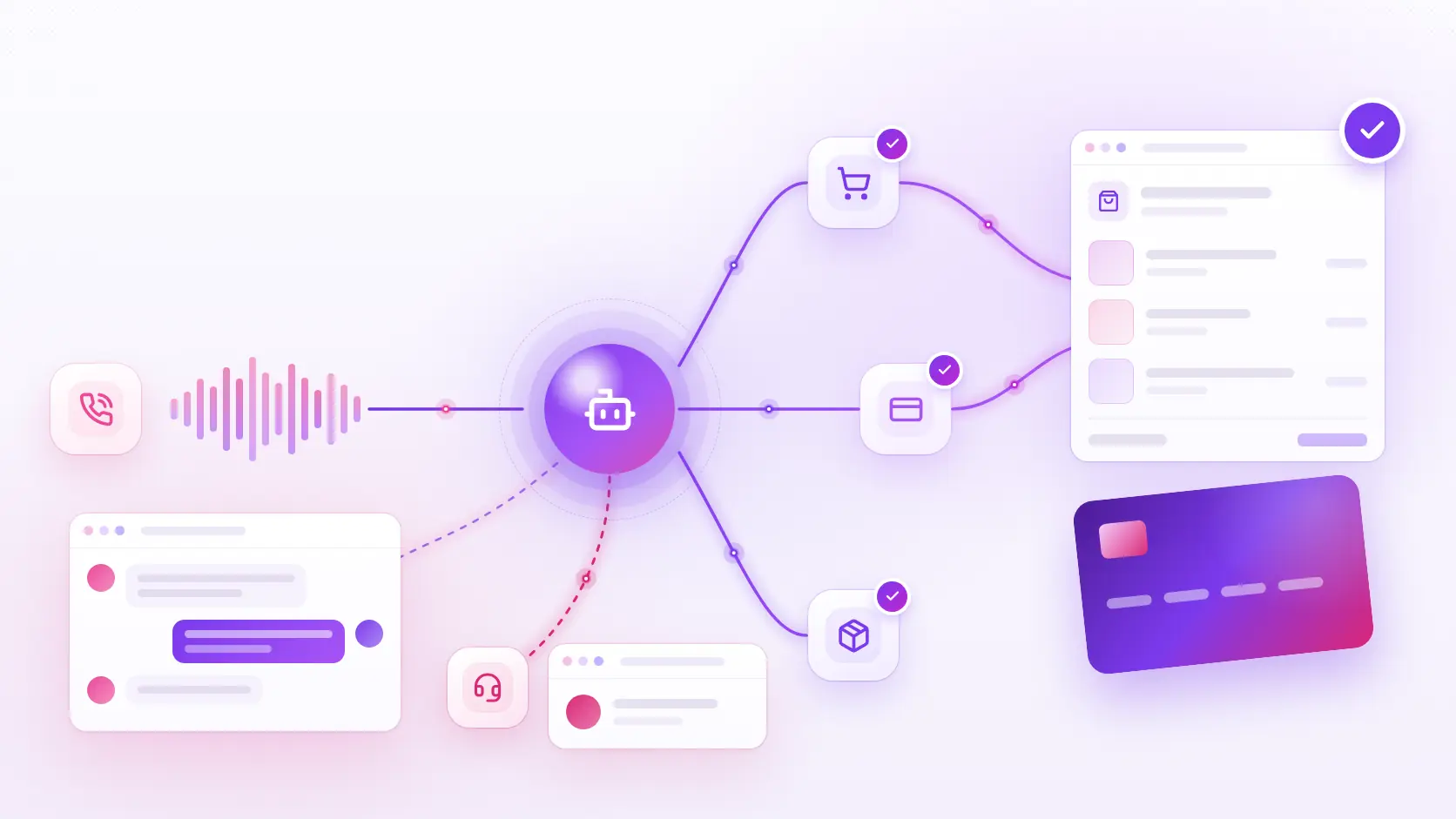
What this looks like in practice
A retailer we're talking to does a large share of its business over the phone. Its busiest season is also when the phones are hardest to staff, and seasonal hires rarely stay long enough to learn the product range.
An AI agent built this way takes routine orders from start to finish, payment included, inside the contact center the team already uses. The people they do have spend their time on the calls that need them, and every handoff arrives with the order already captured.
Design the payment step first
Payment is the part most teams leave until last, and it should come first. How card details are captured decides your compliance scope, what the AI agent is allowed to see, and which parts of the call can be recorded. Settle that early and the rest of the design has clear boundaries.
Start with one high-volume request
You don't need to automate the whole contact center at once. Pick the request that makes up most of your volume, build the agent for that, measure it against your human baseline, and expand from there.
If you want an AI agent that takes the order, not just routes the call, talk to us about what a first build in Amazon Connect could look like.