Getting an AI agent to work in a demo is the easy part. A prompt, a model, a couple of tools, and it's answering questions by the afternoon.
Running that agent for real users is a different job. Every conversation needs its own isolated session. The agent has to remember context. It needs credentials for every tool and API it calls, on behalf of the right user. And when something goes wrong, someone has to see exactly what it did. None of that makes the agent smarter, and all of it has to be built and looked after.
That's the work Amazon Bedrock AgentCore takes on.
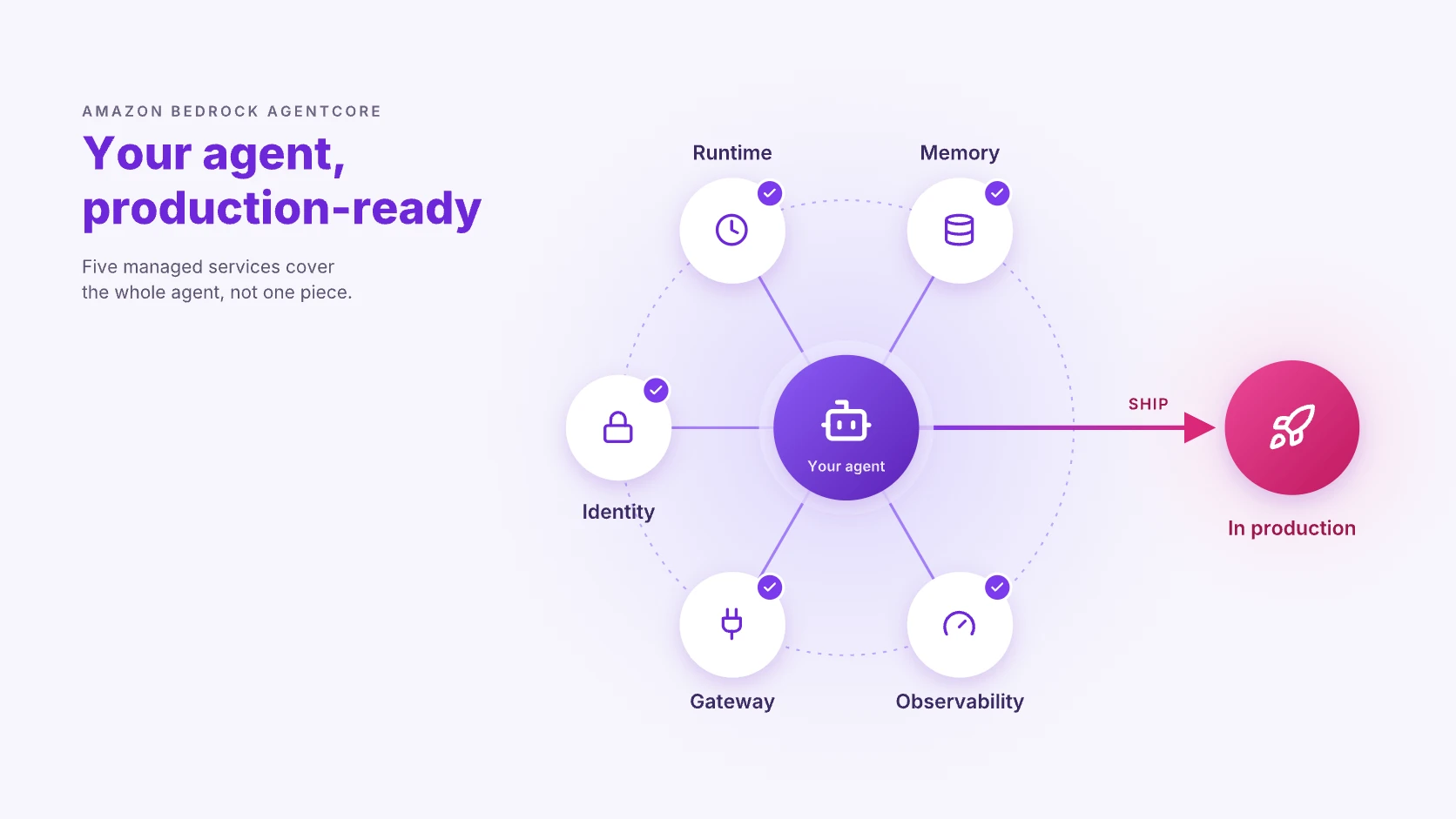
What AgentCore handles
- Runtime. A serverless environment for deploying and scaling agents. Each user session runs in a dedicated microVM with its own CPU, memory and filesystem, which is torn down when the session ends. Sessions can run for up to 8 hours.
- Memory. Short-term memory for multi-turn conversations and long-term memory that persists across sessions, without running your own store.
- Identity. Credential management built for agents. It works with identity providers such as Amazon Cognito and Okta, and handles OAuth flows, token refresh and credential storage for the third-party tools an agent calls.
- Gateway. Turns existing APIs, Lambda functions and services into Model Context Protocol (MCP) tools an agent can use, with built-in search to help it pick the right one.
- Observability. Traces of the agent's reasoning steps, tool calls and model interactions, in OpenTelemetry-compatible format, stored in Amazon CloudWatch.
There's more in the box when you need it: a managed browser, a code interpreter sandbox, and Policy controls that check every tool call before it runs.
Bring your own framework and model
AgentCore doesn't ask you to rewrite the agent. AWS lists support for frameworks including LangGraph, CrewAI, LlamaIndex and Strands Agents, and for models inside and outside Amazon Bedrock. The agent's logic stays yours and stays portable; AgentCore runs it.
The alternative is building all of this yourself on containers. It works, and we've seen teams do it, but it's a platform to maintain: session isolation, scaling, credential handling and tracing, all before the agent does anything new. AgentCore is priced on consumption, with no upfront commitments, so you pay for what the agent uses.
Where to start
Pick one agent and one workflow that matters. Measure it today: response time, cost per conversation, how often it needs a human. Move it to AgentCore Runtime, add Memory and Identity as the use case needs them, and turn on Observability from day one. Then compare.
Talk to our team if you're running an agent on infrastructure you built yourself, or about to, and we'll help you move one agent to AgentCore and measure the difference.