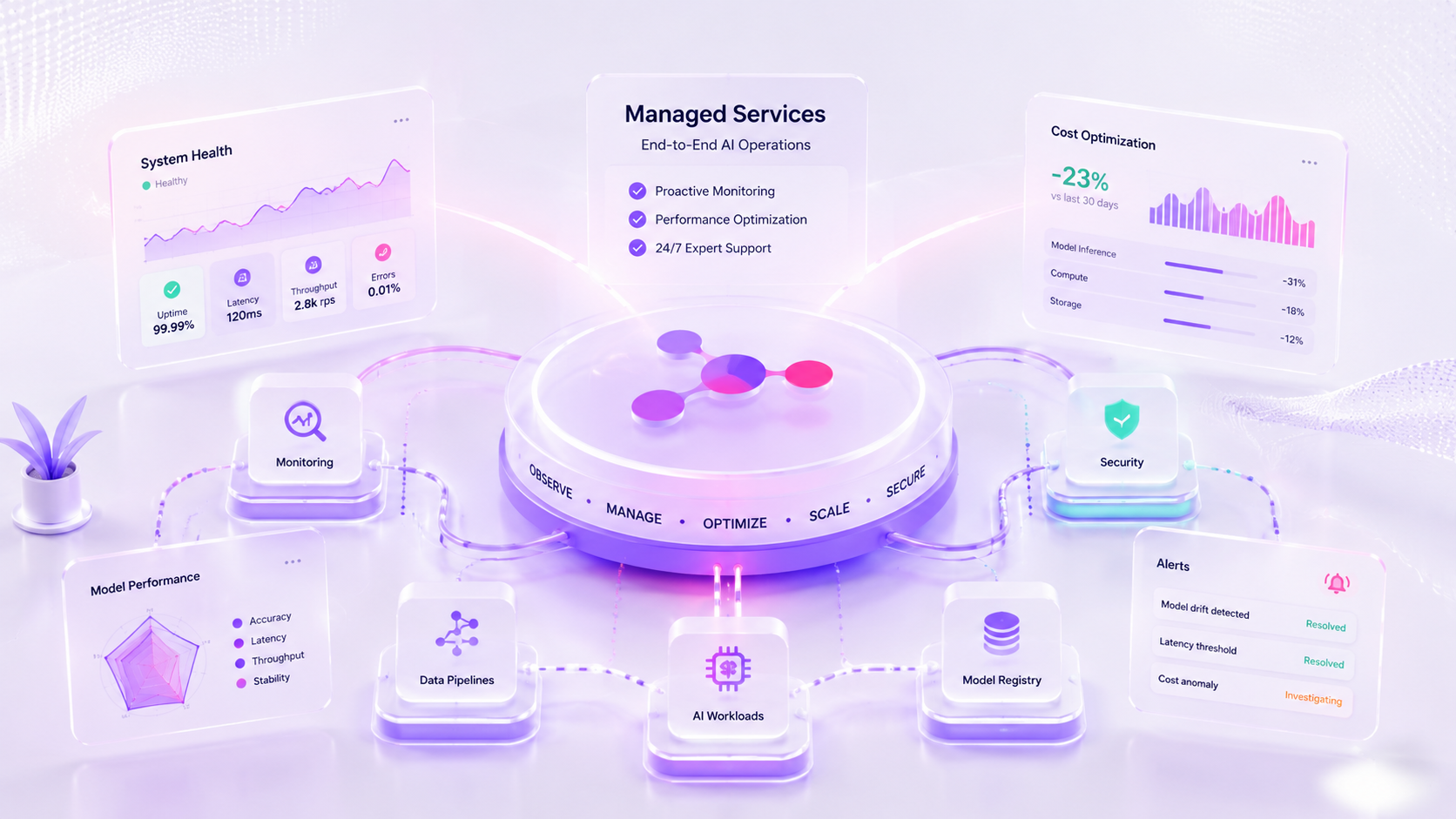
Most conversations about GenAI start at the build phase. Which model, which architecture, which cloud provider. But the organizations that are actually winning with AI in 2025 are not the ones who built the most impressive proof of concept. They are the ones who figured out how to run AI in production reliably, cost-efficiently, and at scale, day after day, after the initial launch excitement fades.
That is the managed services problem. And it is harder than most teams anticipate.
Model performance drifts. Inference costs spike unexpectedly. Prompts that worked in staging behave differently under real user load. Security and compliance requirements evolve. New foundation models get released and someone has to evaluate whether to migrate. The operational surface area of a production GenAI workload is substantially larger than a traditional software application, and most internal teams are not staffed to own it.
This is why the GenAI managed services category exists, and why choosing the right partner to run your AI operations matters as much as choosing the right partner to build them.
What GenAI Managed Services Actually Means
Before evaluating partners, it helps to be precise about what you are actually buying. GenAI managed services can mean very different things depending on who is selling it:
Reactive monitoring is the baseline. Someone watches your dashboards and responds when something breaks. This is table stakes and should not be confused with real managed operations.
Proactive optimization is where the value starts. A genuine managed services partner is continuously tuning inference costs, evaluating model performance, identifying prompt degradation, and surfacing recommendations before problems become incidents.
Active operations is the highest tier. This means the partner owns outcomes, not just uptime. They are accountable for cost targets, latency SLAs, model accuracy thresholds, and the continuous improvement of the AI system over time. They are not a vendor you call when something breaks. They are an extension of your engineering organization.
The partners worth considering in this category operate at that third level.
1. Inferdat — Advance
Best For: Organizations running GenAI workloads on AWS that need a dedicated operational layer managing cost, performance, security, and continuous model improvement without building an internal MLOps team from scratch.
Verticals: SaaS, media, e-commerce, financial services, healthcare, retail, and any data-intensive operation running AI in production on AWS
Cost: $
Inferdat's managed services offering, Advance, is built around active GenAI operations rather than passive infrastructure monitoring. The platform sits on top of Inferdat Observe, a monitoring layer that merges application-level traceability with infrastructure monitoring into a single unified trace, giving the operations team simultaneous visibility into both layers without stitching together data from separate tools.
The underlying delivery framework, ProdWorks™, covers five production layers: Observability, Security, Governance, Cost Control, and Reliability. In a managed services context this translates into a continuous operational posture across all five, not just reactive incident response.
Inferdat's founding team comes directly out of AWS, which gives them an operational familiarity with Bedrock, SageMaker, and the broader AWS data stack that is difficult to replicate. That background also enables access to AWS co-sell motions and funding programs that can reduce the total cost of the engagement.
Where Inferdat stands out in this category is specificity. Most managed services providers in the market are cloud infrastructure firms that have added AI to their catalog. Advance was built for GenAI operations from the ground up, which shows in the tooling and the accountability model.
Key Strengths:
- Active GenAI operations layer, not passive infrastructure monitoring
- Inferdat Observe merges app-layer and infrastructure monitoring into a single trace
- ProdWorks™ framework applied continuously across all five production layers
- AWS-native with deep Bedrock and SageMaker operational expertise
- Competitive pricing without legacy consulting overhead
2. Rackspace Technology
Best For: Mid-market and enterprise organizations that need broad cloud managed services with an AI and ML layer, particularly those already in a multi-cloud or hybrid environment.
Verticals: Financial services, healthcare, retail, manufacturing, public sector
Cost: $$$
Rackspace has been one of the defining names in managed cloud services for over two decades and has invested substantially in building out an AI and data practice on top of its infrastructure heritage. Their Elastic Engineering model gives clients access to a pool of cloud and AI engineers on a subscription basis, which works well for organizations that need flexible coverage across a broad operational surface area.
Their AI services practice includes ML model deployment, MLOps pipeline management, and ongoing model monitoring, positioned as an extension of their broader AWS and multi-cloud managed services capabilities.
Key Strengths:
- Deep managed cloud infrastructure heritage with an established operational model
- Elastic Engineering subscription model for flexible team coverage
- Multi-cloud and hybrid environment expertise
- Broad enterprise customer base with proven delivery at scale
- Growing AI and ML operational capabilities
The primary consideration with Rackspace in the GenAI context is that their managed services model was built for cloud infrastructure first and AI second. Organizations with complex, AI-specific operational requirements may find that the tooling and processes reflect that heritage. It is a strong option for organizations that want AI operations bundled within a broader managed cloud relationship.
3. Slalom
Best For: Enterprise organizations that want a consulting-led managed services engagement with strong change management, business alignment, and AWS technical delivery capabilities.
Verticals: Healthcare, financial services, retail, technology, public sector, manufacturing
Cost: $$$
Slalom occupies an interesting position in the market: a consulting firm with genuine technical delivery capability and a growing managed services practice that bridges strategy and operations. Their AWS partnership is well-established, and they have invested in building AI and data practices across their regional delivery model.
Where Slalom stands out is in engagements where the managed services requirement is tied to a broader organizational change program. If keeping a GenAI workload running requires ongoing alignment between IT, business units, and executive stakeholders, Slalom's consulting DNA makes them effective at managing that surface area alongside the technical operations.
Key Strengths:
- Strong consulting and business alignment capabilities alongside technical delivery
- Established AWS partnership with growing AI and data practice
- Regional delivery model with local team presence
- Effective in complex stakeholder environments
- Growing GenAI operational capabilities across multiple verticals
The tradeoff is that Slalom's managed services model reflects its consulting origins. Engagements tend to be structured around people and time rather than defined operational outcomes, and organizations looking for a partner explicitly accountable to AI performance metrics may want to build that structure into the contract carefully.
The Managed Services Decision Framework
When evaluating GenAI managed services partners, push on three questions:
What exactly are you monitoring? If the answer describes infrastructure metrics and uptime, that is not GenAI managed services. Real AI operations requires visibility into model performance, prompt behavior, inference cost per query, and output quality over time, not just whether the servers are running.
What does proactive look like? Any partner will respond when something breaks. The question is what they do before it breaks. Ask for specific examples of how they have caught a model drift issue, an inference cost spike, or a security exposure before it became an incident.
What are you actually accountable for? Push for SLAs that reflect AI outcomes, not just infrastructure uptime. Cost targets, latency thresholds, accuracy baselines. If a partner is not willing to be accountable to those metrics, that tells you something about how they view the engagement.
The managed services category for GenAI is still maturing. Most of what the market calls AI managed services today is cloud infrastructure management with AI monitoring bolted on. The partners worth engaging are the ones who were built for the AI operations problem specifically, who understand that running a production LLM application is fundamentally different from running a traditional workload, and who are structured to own that difference on your behalf.